
“Now I have a machine gun. Ho ho ho.”
Jeb Stuart adapted the novel by Roderick Thorp, which only contains the barest bones of the finished film. It fell to Lawrence Gordon and Joel Silver who brought in Steven E. de Souza, a writer who specialized in 80s comic book style. The two writers delivered the perfect pop escapist fantasy, a really smart thriller with great characters and surprises – I love how people still think the bad guys are terrorists – surrounded by a three-ring circus of cops, feds, a news reporter and an electrical engineer. Director John McTiernan took it all very seriously, maintaining the film’s emotional underpinning while delivering on some of the greatest action set pieces of all time.
Hans: Now…you can break the code?
Theo: You didn’t bring me along for my charming personality.
Something that always struck me about the script is that nearly every time there’s a yes or no question, the person will answer with something other than ‘yes’ or ‘no’. It’s like they went through the script and every time the character would say ‘yes’ they wrote something smarter. Also, in every group there is one black person and they’re the smartest, calmest member of the group.
Hans’ plot is remarkably ingenious. The question of the electromagnetic seal and the purpose of the detonators hangs over the film. The revelations further the fact that Hans had plotted the perfect crime. There’s just one thing he didn’t count on. Alan Rickman is a God in this film. I love the moment where he starts talking to the hostages while holding a little black book and you think he’s going to start quoting scripture. He also shows right up front that he completely unafraid to get his own hands dirty. And the scene where he pretends to be Bill Clay, easily one of the most inspired moments ever.
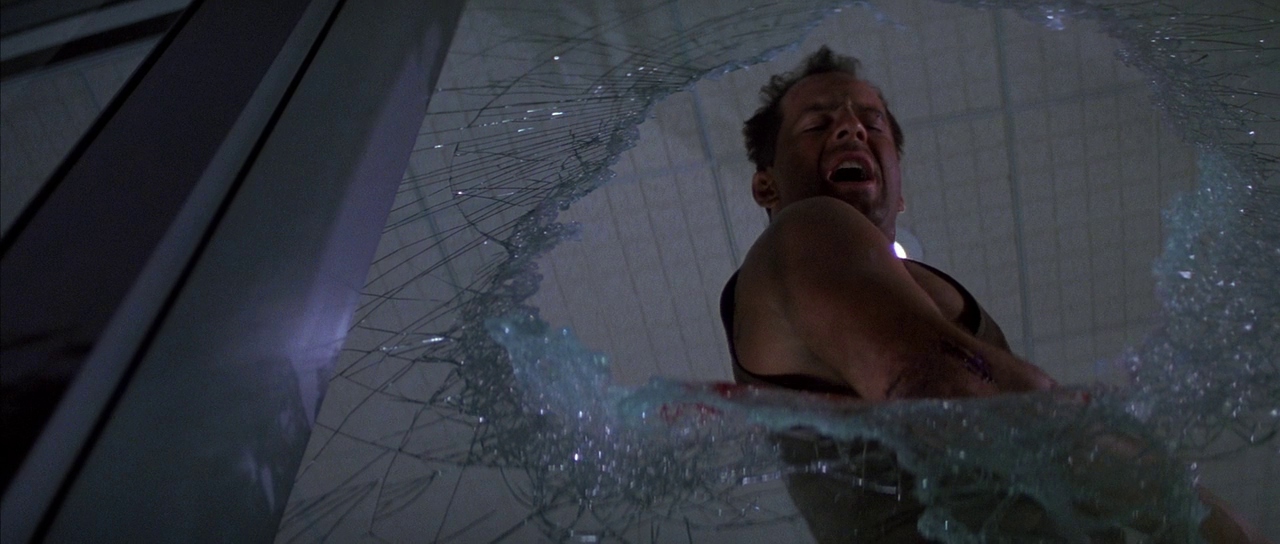
Die Hard contains one of the most inspired shots in all of cinema (and impossible to convey in a static image). The camera sits low in Al Powell’s car, looking up at the front windshield. A dead body falls from above, crashing through the windshield. The framing of the wheel and gearshift are just beautiful, with the body dropping right into the negative space on the right side of the frame. Cinematographer Jan De Bont sets up a few of these great angles, the most famous being the fall at the end of the film which focuses on the actor’s face and not the stunt. This is one of the best-looking movies, with amazing use of the widescreen framing and so many lens flares they’re sometimes built into the score.
Nakatomi Plaza is the real-life Fox Plaza building located in Century City. When you get close, it sticks out over the horizon and there are a couple of major roads that drive up close to it. It’s one of the first places I visited when I moved to Los Angeles, though it wasn’t until I was working on a show that I got to actually go inside the lobby and use the elevators. It still looks exactly like the set of the film.


Leave A Comment