
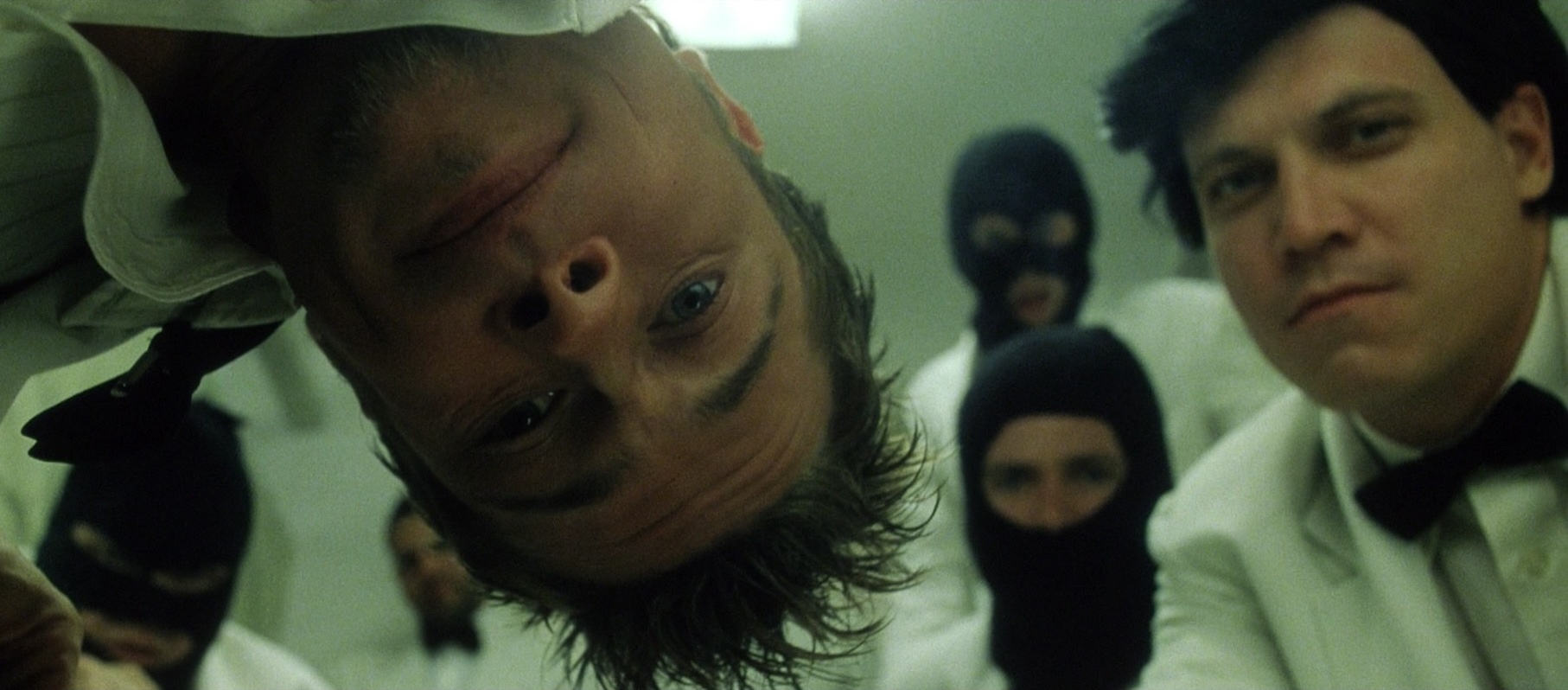
“People are always asking me if I know Tyler Durden.”
Fight Club is a product of Gen X 90s. The current generations aren’t dealing with boring materialism but unemployment and poverty. Anarchy wasn’t an intriguing or exciting proposition in the 2010s, but in our current times a desire for revolution has come back into favor. Fight Club spoke to me as a whacked-out idea, but it spoke to me a lot more as one of the great directorial tour-de-forces. I’ve continued to find new things to enjoy about it as I’ve grown into marriage and the “IKEA nesting instinct.”
I’m not immune to its flaws. It’s remarkable density causes pacing problems towards the end, and two things completely contradict the twist – the dialogue leading up to the car crash and the fact that guys saw the first fight and wanted to join in. (Think about it). However, Fight Club is a brilliantly executed piece of cinema in every department. You can’t say that Hollywood is afraid of fresh ideas when they backed this, which thrives on unpredictability right up to its final frame. As for the twist, I would put it among my Top 3 of all time. It changes so much about the film, especially Marla’s part to play in it.
This was Helena Bonham Carter’s break from her corset films, and the transformation is effortless as she sulks and quietly spits out out her tarty lines like Courtney Love on depressants. I don’t know how somebody looked at this part and said “get me Helena”, but this is her most convincing, sexy and fascinating performance. All three leads are remarkable. Pitt fits his role like a glove, and I love the sexual tension between the three of them.
This was Fincher’s fourth film and remains his best directed. His control over the look and mood is every bit as good as Stanley Kubrick. The chemical burn scene is my favorite example of sound editing and smash cuts. It’s interesting to note because so many scenes are brief – note how many locations are used for 1 or 2 shots – this was mostly shot on French hours. What that means is the work days were shorter to avoid paying the usual overtime to the crew, and there would be no official break for a meal though food was always available. Fincher could then maximize takes by limiting the number of setups for a scene.
I usually don’t respond strongly to satire, but with Fight Club it’s easy to see the humor. It’s not an oppressive film. It wants us to be free, to live and do something with our lives, and it’s all presented in a very gleeful way. You can’t watch the final shots and say this isn’t a comedy. Possibly the most uneasy and violent comedy ever made.


Leave A Comment