
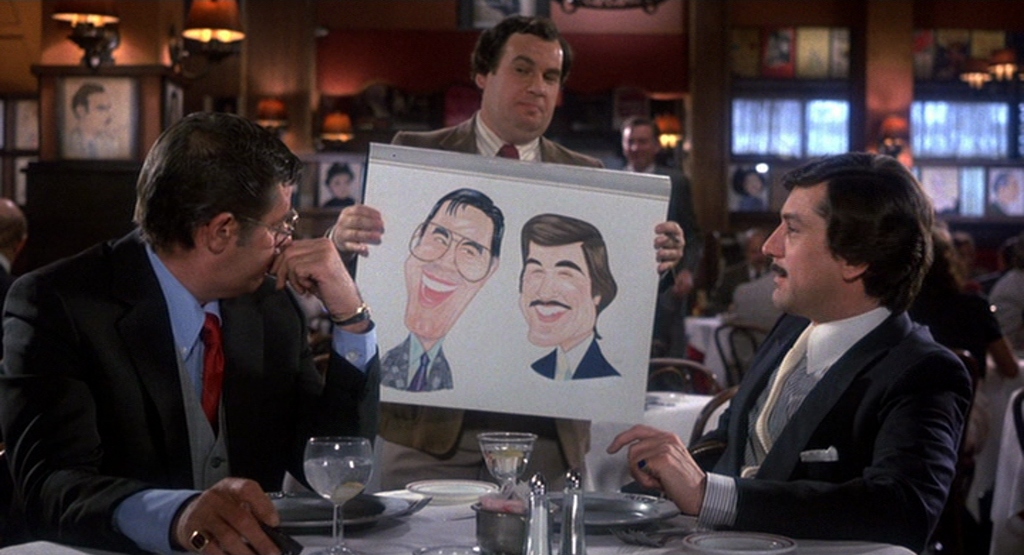
An interesting lesson for aspiring filmmakers is to compare Scorsese to David Fincher. Fincher will do take after take until everything is perfect, the performances and the technical qualities. King of Comedy has a number of continuity errors: a bandaged hand, drink levels, the configuration of tape, phones. This doesn’t bother Scorsese, who is laser focused on the acting. He’d never throw out a great performance because of continuity errors. With a director at the level of Scorsese, there are the acknowledged classics and then everyone has a pocket favorite. Scorsese has two of those, titles that were labeled ‘lesser’ works at the time that have grown to be the filmmaker’s secret masterpiece. One is Casino, which is on this list and will come up later. The other is The King of Comedy.
Every time I watch this, I like it a little more. De Niro played a lot of antisocial misanthropes for Scorsese, and this may be my favorite of the bunch. (Not the best – that would be Taxi Driver – but my favorite.) Rupert Pupkin – my God, what a name – is such an unlovable loser, but the way he can’t help himself is tragically funny. It’s one of the earliest examples of cringe comedy and one of the most extreme. You want to recoil from some of his behavior, but it’s too fascinating to watch. I think this movie’s slow rise to respectability is due to Sandra Bernhard, a performance artist whose cringe is much stronger, but the rest of the film is so successful, so unique and so good it easily survives.
p.s. The birth of Cringe Comedy I think belongs to Elaine May, with 1971’s A New Leaf and 1972’s The Heartbreak Kid



Leave A Comment