
You know, everybody dies. My parents died. Your father died. Everybody dies. I’m going to die too. So will you. The thing is, to have a life before we die. It can be a real adventure having a life.
Had The World According to Garp not been based on a book by John Irving, had it not been made by one of the most underappreciated Great Directors (George Roy Hill) and had it not disappeared from public consciousness, I still wouldn’t know where to start talking about it. Garp is a slightly strange, mostly wonderful movie made from a great unfilmable novel, and it’s mostly known as that Robin Williams movie where John Lithgow plays a woman and a small plane flies into a house. (The worst moment in the film because it comes from nowhere and leads to nothing.) I feel like I’m trying to describe a stained-glass window to a blind person.
I have read the book, after seeing the movie quite a few times and hearing from many that the book is much better. The two are different enough to stand on their own. The book catalogues events big and small, some wildly random but with an internal logic. The film is more straightforward, but does an amazing job adapting the key moments without feeling like greatest hits from the book. It pulls apart the mechanics that work best as a novel and rebuilds them into a great movie.
This is a good first step, but requires a director who can lasso the tragi-comic elements into a solid emotional core. This is why George Roy Hill is a genius, because what happens in Garp is a cocktail of Forrest Gump, Royal Tananbaums, Charlie Kaufmann and a dash of Todd Solondz. Hill worked this magic once before, in the equally underappreciated adaptation of the even more famous work Slaughterhouse Five by Kurt Vonnegut. Hill’s film is very funny, even though it’s a drama and touchingly real even though it features Lithgow as that football star post-op. There’s also a shot in this film that’s one of my all-time favorites. It’s a surprise moment of tragedy so I can’t go into detail, but Hill keeps the sound going while he freezes the frame and slowly pushes in on a single character, letting your mind put it together. Just brilliant.
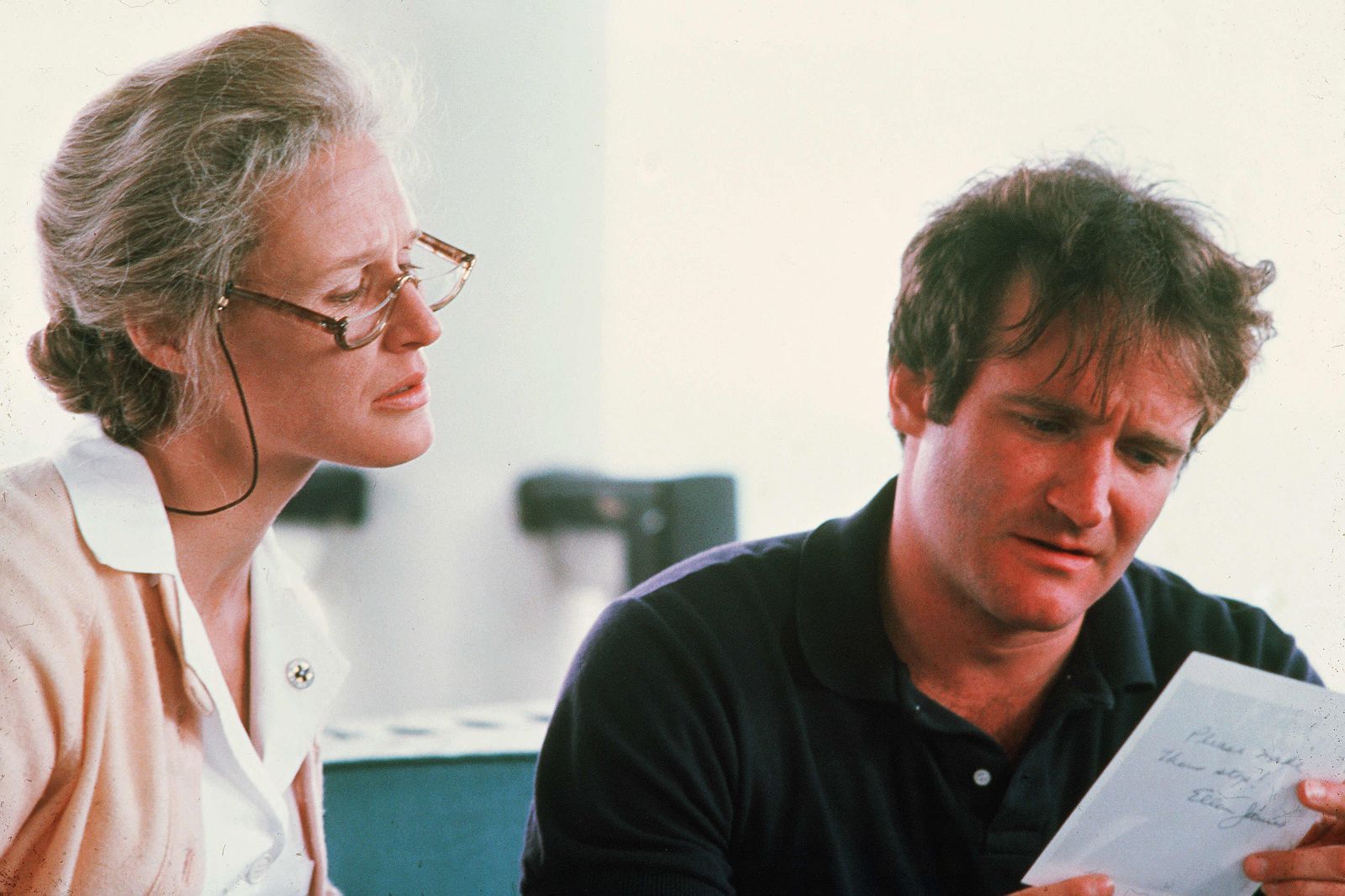
Lithgow is great as is Williams in an early performance that showcased his major dramatic chops. He gets a couple of moments of Williams silliness, but this mostly a sad, pushed around kid who doesn’t have enough drive to avoid life’s troublesome temptations. His heartfelt reconciliation towards the end of the film may be Williams’ finest moment (and I’m not forgetting The Fisher King.) His rock-solid center leaves the rest of the world open for Glen Close, as this feminist man-weary nurse mother, to run away with the picture. It’s not a fault of the film that she’s steals Garp, it’s like faulting Dark Knight for letting The Joker steal it. I mean how can you not? What could easily have been a one-dimensional castrating cartoon is given three-dimensional credibility in Close’s performance. As nutty as her logic sometimes got I kept thinking to myself ‘I know this woman.’ I’ve met her kind before, and they’re just as logical in their arguments. You should see the movie for her work alone.



Leave A Comment