
“Give the guy a gun and he’s Superman. Give him two and he’s God.”
Occasionally, I will go away from Hollywood to cover a film too interesting to ignore. In 1990, the record program on my VCR started a half-hour early and recorded the last 30 minutes of John Woo’s The Killer. That’s how it all started, with a movie I accidentally recorded and then played endlessly. The 3rd Act of The Killer was and still is some of the greatest action choreography ever put to film. It didn’t matter that people never ran out of bullets and that they often ran at the guy they were shooting rather than taking cover. The artistry of the bullets, blood and that church full of doves changed me. The film has the power to open people’s eyes to action cinema possibilities never imagined.
There’s been some re-evaluation of filmmaker John Woo and the lasting impact of his films. Hong Kong actioners became the cult hot spot in the late 80s/early 90s, and Woo sat at the top of the heap. He turned gunplay into dance and injected fresh blood into the action genre. Hollywood couldn’t wait to import him. Unfortunately, either Hollywood sucked the creativity dry, or Woo had run out of ideas. Even his best moments in America paled to the insanity he whipped up in HK.
Now, I return to the well with one of the coolest films ever made, yet doesn’t feel like it’s trying to be cool. More like Woo had a story about cops and criminals and working undercover and friendship and decided the best way to explore these themes was through lots of gunfire. The film kicks off the moment Tequila (Chow Yun-Fat) stomps on the bottom of the bird cage and two guns fall out. Before that, Woo lays out the geography of the tea house beautifully. His camera glides around until we can diagram where the good and bad guys are sitting. You clearly know where everybody is in the room, which is very helpful when the scene erupts in absolute nutso bonkers chaos.
This isn’t just great action choreography, Hard-Boiled arguably contains the Greatest Gun Battles of All Time. Woo has repeated a couple of the gags in his later Hollywood films, like the moment where Tequila jumps over one downed motorcycle while firing a shotgun at another. The big budget version felt too choreographed and lifeless. For all the slick coolness, the action here has a rough organic quality. It doesn’t just earn passive approval, it knocks you too dizzy with excitement. These aren’t the greatest stuntmen money could buy, but a bunch of imaginative knuckleheads who didn’t know better to play it safe.
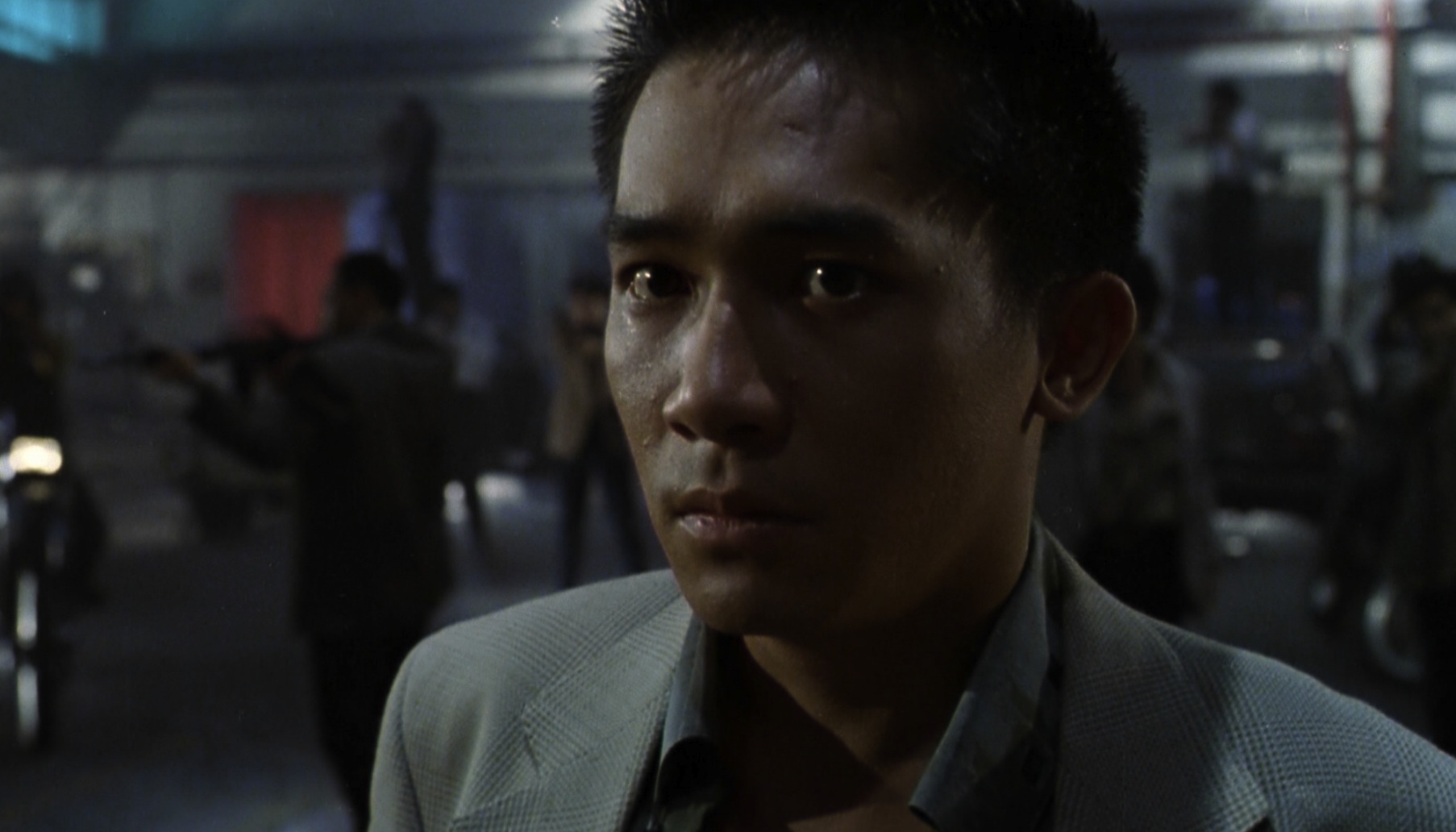
Matching the operatic action are the performances by Chow Yun-Fat and Tony Leung. Chow is one of the most charismatic performers in the history of cinema, and he’s at his most commanding here. I’m talking Errol Flynn in Robin Hood charisma. Leung matches him with an expressive inner torture while the events continue to eat away at his soul. It reminds me of his work in Infernal Affairs, but on a more heightened stage. And again, it’s the eyes, particularly in the moment when he must betray his old gang boss and during the (obligatory) face off with Yun-Fat. Tequila pulls the trigger and clicks. Tony realizes this man meant to put him down and must make a moral choice with his loaded weapon. His facial reaction is spot-on brilliant. (Woo elevates the moment one step further by revealing Tequila’s gun jammed and was not out of ammo.)
I can understand people getting tired of the action before the film is done. The hospital climax is actually the least of the 4 mega set pieces (birdcage tea house, auto warehouse and the underappreciated wharf battle). There are too many breaks in the action at the hospital, too much time away from our main characters and more dialogue than you need. However, it also contains the justifiably famous (almost) single take lasting nearly 3-minutes where our heroes destroy the bad guys on one floor, get into an elevator for some dialogue (while the Set Dressers rebuild the Set) and then get off on another floor to destroy more bad guys.
Leave A Comment