
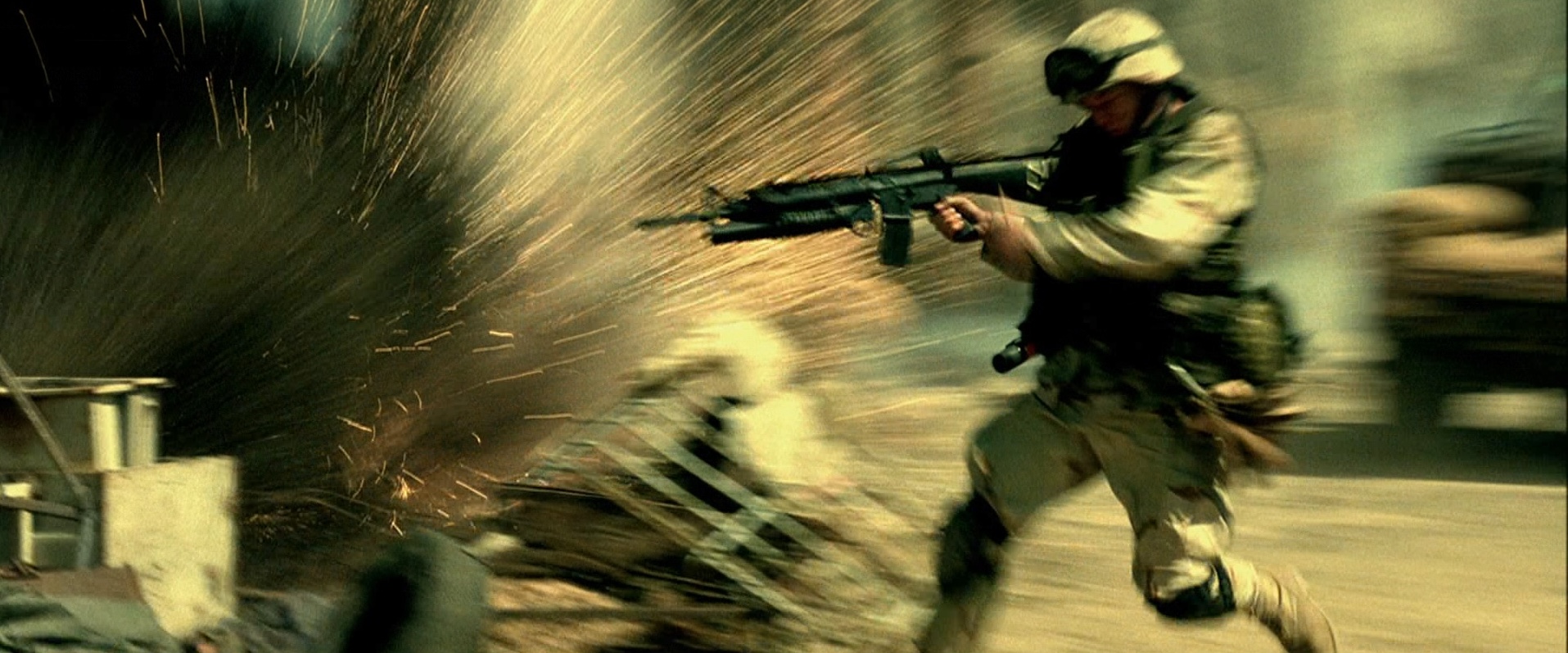
Black Hawk Down unnecessarily starts by trying to explain why American soldiers were in Mogadishu in 1993. There’s no way to set up the entire political situation in a handful of title cards, and it actually has little bearing on what Ridley Scott is doing with the material. This is not a political film about war, but a human film. This is about the madness of combat; about men who got into a bad situation and did whatever they could to get everyone back to safety.
Scott is one of the most professional craftsmen in the business. A director who will never get overwhelmed by a story’s scope, he can film any chaotic situation, take on any large-scale enterprise and with the utmost calm, know exactly where to put the camera. This is an exceedingly well-shot (and well-edited) film, and none of it is done to be flashy and stylish. Scott has evolved beyond having to prove to us how cool he can be. It feels very natural, and the story is gritty and realistic without sacrificing quality lighting and composition. What he and his team created here is one of the most realistic depictions of a military operation I’ve ever seen.
Behind the scenes, Scott made a very smart decision that is still talked about on sets. The story begins in the daytime, but ends deep into the night. Usually that means at some point the crew goes into filming nights for weeks on end, which is exhausting and disorienting. 1st Assistant Director Terry Needham established a schedule where each day went from Noon to Midnight. The crew would work on a Daylight scene, go to lunch and then film something from the Night part of the script.

Leave A Comment