
I don’t remember what led me to rent The Ninth Configuration for the first time, but I remember I watched it three times that day – twice by myself and once with friends. My most precious buried treasure, this is the ignored child I give special attention to. I’ve read the original novel, tracked down a copy of the shooting script, watched three different cuts of the film and read the novelization of the finished film. (All versions were done by writer/director William Peter Blatty and watching the evolution of his themes and ideas, the way he attacks the same big concept from different angles, is fascinating unto itself.)
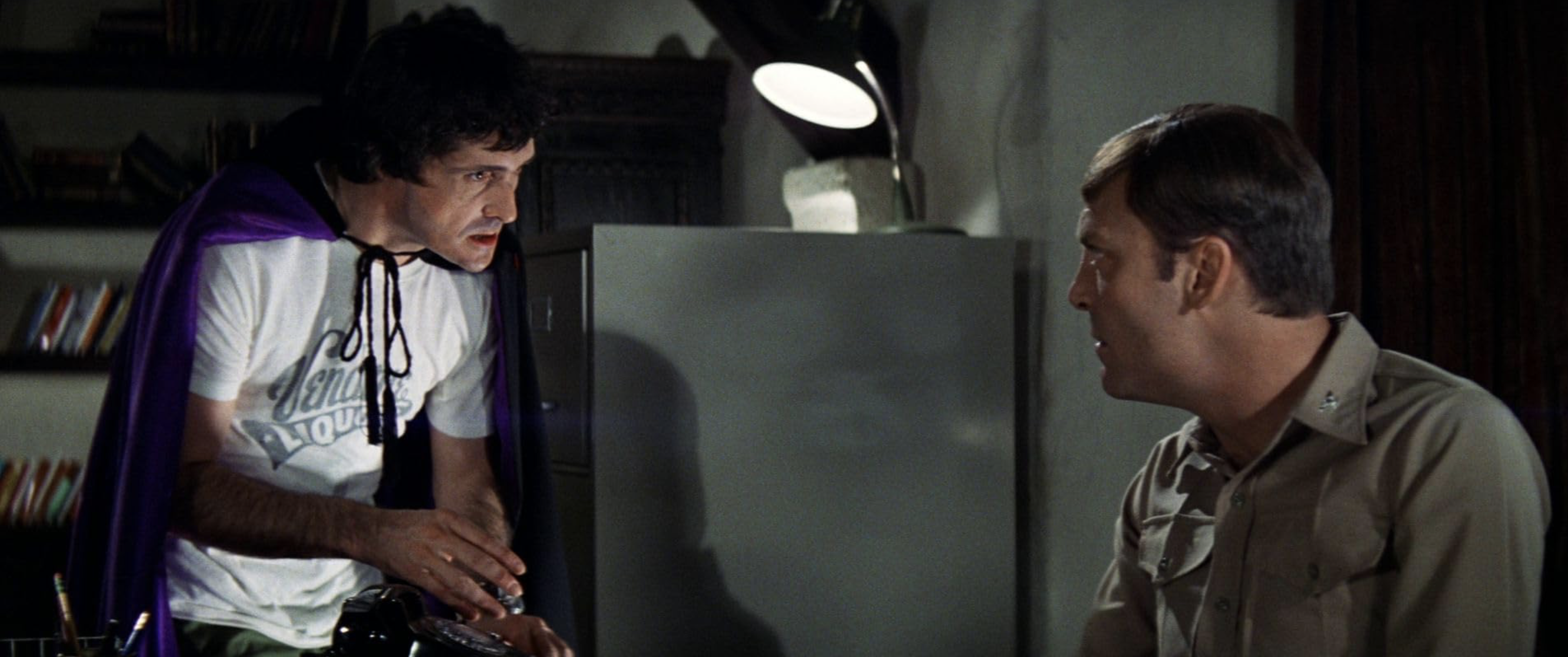
On the surface, The Ninth Configuration is your standard “inmates in an insane asylum” comedy with lots of hilariously non-sensical dialogue. (“Stick a pineapple up your ass and pretend your Hawaiian.”) The inmates include someone who wants to adapt Shakespeare for dogs, a tough guy who believes his molecules can pass through solid matter, a black Superman, and most importantly an astronaut named Cutshaw who freaked out just before his trip to the moon. Into this world comes a new psychiatrist, Kane (Stacy Keach) who decides to indulge the patients.
Cutshaw: Take me to the beach.
Kane: It’s night, and it’s raining.
Cutshaw: I see you’re determined to start an argument.
The plot moves forward on two parallel mysteries. Why wouldn’t Cutshaw go to the moon, and just who is this new psychiatrist? Throughout the therapy sessions there are many signs that Kane isn’t completely well himself. Using flash cuts and horror film music cues, Blatty doesn’t hide the fact that Kane isn’t quite operating with a full deck, but he doesn’t reveal everything until the 3rd Act. Even if you think you have it all figured out, there’s still a surprise or two that changes the main character dynamics and greatly rewards a 2nd viewing.
In the meantime, the meetings between Kane the therapist and Cutshaw the astronaut are funny, tense, philosophical, and thought provoking. (The only thing Blatty hasn’t done with the material is put it where it truly fits… on a live stage.) The dialogue is too arch and self-conscious, but is so thoroughly quotable I have no complaints. These two stories, both of which question the existence of God and his presence on earth culminates in an extremely intense final act that pulls the rug out from anyone who believes they are watching a comedy. I can’t spoil since most of you have yet to see the film, but there’s some heavy 70s exploitation going on, and it’s never been used to class up a film so much. Plus, there’s a nearly silent shot – a person stands up leaning to one side, the camera rises with him while tilting the other way – that’s among my all-time favorites. It ties your stomach in knots because you know what’s about to happen.


Leave A Comment